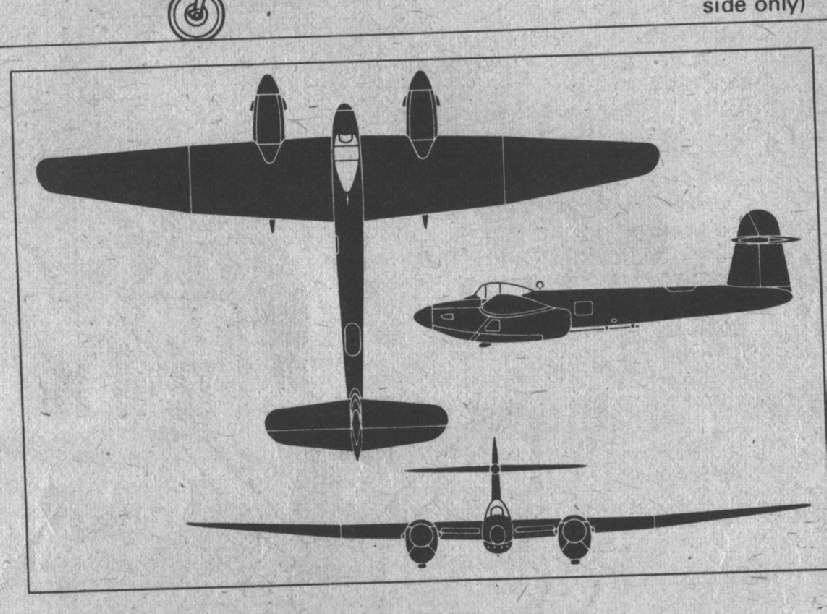
"They should have given it Merlins"
Very often, when talking to enthusiasts about our project, a comment is made along the lines of 'It would have been a world beater with Merlins'
Over to our Chief Engineer, Pete Smith:
"Its a long standing debate that requires an engineering response. First off, being fair to the Peregrine, it was a good engine that was very mechanically reliable. It had some initial overheating issues which were addressed and corrected (Matt's note - this had a lot to do with the intake shape). The rated horsepower was set at 850 HP using 80/85 octane fuel with a low continuous boost pressure. The supercharger and boost pressure had been optimised for maximum delivery at the altitude where the Air Ministry strategists considered any potential German bombers would operate.
It is too simplistic to think just fitting more powerful engines would have increased the Whirwind's performance. To transmit the additional horsepower of the Merlin would also require larger 5000-series propellers and brackets. Here lies the real problem - the sweep of the 5000-series propellers (for example the Spitfire's 5/39 with 55409 blades - minimum diameter indicated by the diagram below), is larger that the propellers used on the Whirlwind.
The Whirlwind was specifically designed around the Peregrine engine and had insufficient ground clearance on take off and landing to accept the larger propellers. Four bladed variable-pitch propeller hubs had not then been developed.
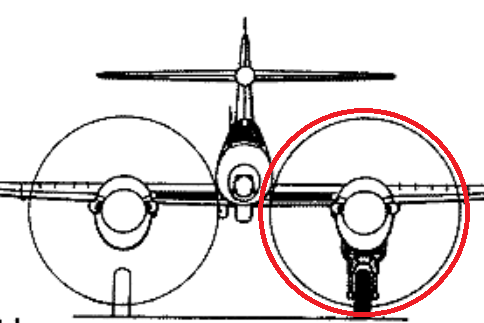
Clearance was already marginal with 4000-series blades cut down by the maximum 9 inches to 10ft diameter. Westland had to obtain a dispensation from the Air Ministry to run higher than specified tyre pressures, which created problems when landing on soft grass airstrips.
The Whirlwind was known as a tail-light aircraft, which would have been exacerbated by the increased weight forward. The fitting of Merlins would have required an extensive redesign of the airframe, the wider sweep of the propeller necessitating longer undercarriage legs - this in itself would require longer nacelles to house them. This redesign was not simple as the operating hydraulic undercarriage and flap jacks were attached to the rear wing spar, requiring a new wing design.
Also, the Merlin is physically a much larger and heavier engine - 1,385 lbs dry against the Peregrine's 1,140lbs. Installing a Merlin, (with sufficient clearance for its updraft supercharger in front of the wheel bay - Matt) would have moved the aircraft's centre of gravity forwards, outside of the design limits. The diagram below loosely indicates where the Merlin would have needed to be placed to fit with the existing design.
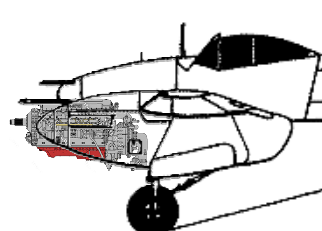
Westland did propose a Whirlwind fitted with Merlins, as internal correspondence has indicated. Very little information exists as to the design and it was never developed in detail as the proposal was rejected by the Air Ministry.
Westland then went on to design the Welkin, a Merlin powered high altitude fighter. While superficially similar to the Whirlwind, it was of a very different design and construction, incorporating a single spar wing with a somewhat larger airframe".
Matt Bearman adds:
The only indication of a Merlin solution came from Westland Drawing 84132 dated 6th December 1940 and which now seems lost. A version was reproduced in Aviation News magazine in 1982, and was unearthed by Jerry Brewer in 2011. I have included it below. Note the deletion of the cannon nose, longer rear fuselage and greater aspect ratio to address the cg issues Whilst it looks like a Welkin, it is an earlier iteration, closer to a 'Merlin Whirlwind' with similar wing, tail and rear fuselage profiles.